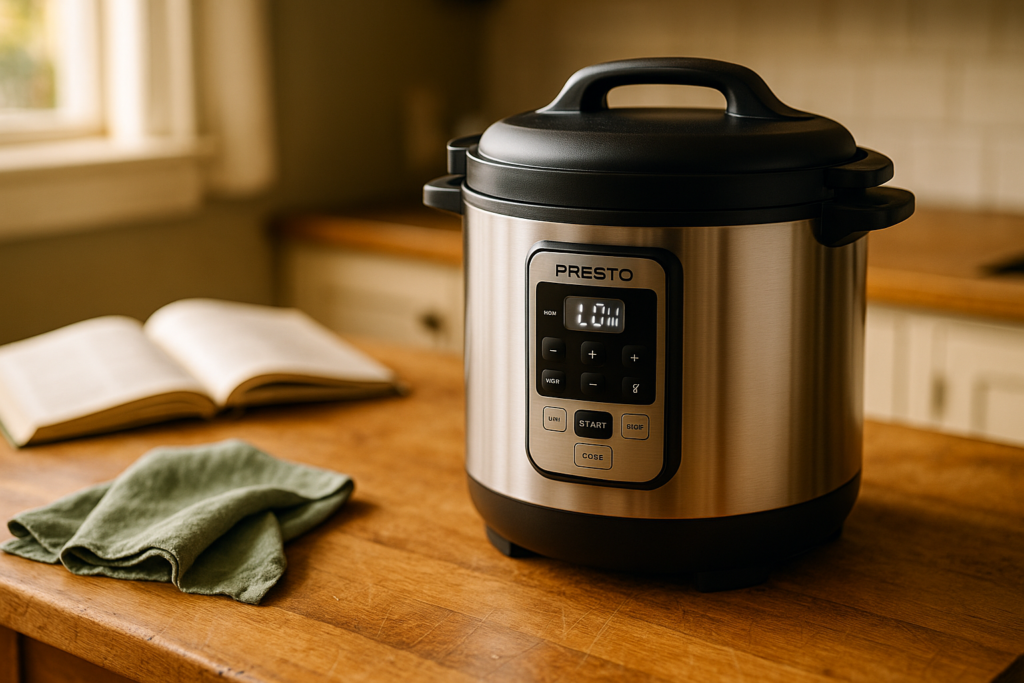
Choosing a presto electric pressure canner can feel overwhelming when you want pantry-ready meals but worry about buying the wrong equipment. Between jar capacity, countertop space, and conflicting safety claims, there is more to consider than a convenient digital display. I’m Sarah, a home baker who values practical kitchen tools and clear instructions, especially when food preservation is involved. This guide explains the main canner types, the features worth checking, and the Presto 02144’s strengths and limitations without treating manufacturer claims as independent validation. You’ll learn how to compare your options, understand current canning guidance, and decide whether an electric model suits your kitchen.
What Is a Presto Electric Pressure Canner and Why Does It Matter?
A digital display cannot tell you whether your pantry food is safe. A presto electric pressure canner is designed for preserving food in jars—not merely cooking dinner under pressure. As a baker, I appreciate helpful automation, but preservation demands more than convenient controls.
How does an electric canner differ from a stovetop model? A purpose-built electric canner combines its own heater with electronic controls that guide or automate processing stages. A stovetop pressure canner relies on your burner and manual adjustments. Neither design removes the need for a supported process and careful operation.
Why does pressure canning matter? Low-acid foods, such as green beans and meat, can support toxin production by Clostridium botulinum when improperly canned. Pressure canning enables temperatures above boiling, typically around 240–250°F, needed for tested low-acid processes. Unsafe jars may look and smell normal.
Is boiling-water canning interchangeable? No. Water boils at about 212°F at sea level, with lower boiling temperatures at higher elevations. Boiling-water canning is appropriate for sufficiently acidic foods, including properly acidified products, when a tested recipe specifies it. Choose the method by food and recipe—not convenience.
Does reaching a displayed temperature or pressure establish safety? No. Tested processes account for heat reaching the coldest part of the food, not just conditions inside the appliance. Follow requirements covering:
- Food preparation, jar size, and packing method.
- Venting, processing time, and altitude adjustments.
- Heating and natural cooling behavior.
Do USDA recipe references mean USDA product approval? No; USDA does not approve individual home canners. Manufacturer assurances alone also do not establish independent validation. Consult current NCHFP and university-extension guidance before selecting a model or process.
Does guidance against electric multicookers prove every purpose-built electric canner was tested and rejected? No. Those warnings are not product-specific evaluations of every dedicated model—but a “canner” label is not proof of suitability either. With that distinction clear, let’s examine which features deserve scrutiny before buying a pressure canner for canning.
Key Features to Check Before Buying a Pressure Canner for Canning
Before buying a presto electric pressure canner, I’d start with your actual batches: pint-sized meals, quart jars, or large harvests? A smaller chamber may suit weekly meal prep but require repeated cycles for garden surplus. Nominal quart capacity describes vessel volume—not how many quart jars fit.
- Usable jar capacity: Check the current manual for your exact model’s capacity by jar size and permitted jar shapes. Verify every numerical specification against that manual. Never infer quart-jar capacity from the appliance’s name.
- Approved stacking: Confirm whether multiple layers are allowed, which jar sizes qualify, and whether an additional rack is required. Watch out: physical fit does not establish an approved configuration.
- Countertop fit and weight: Check the footprint, lid-opening clearance beneath cabinets, empty weight, and filled-use placement requirements. Plan to fill, run, and cool the appliance in place rather than move a hot, loaded canner.
- Electrical requirements: Verify voltage, wattage, outlet and grounding requirements, and any restrictions on extension cords. Follow the manual’s placement instructions; don’t assume an available outlet makes a crowded counter suitable.
- Lid, seals, and racks: Look for clear locking indicators, accessible cleaning instructions, and model-specific replacement gaskets and racks. Check parts availability before buying, including service options for electronic components.
- Cycle guidance and warranty: Read the actual venting, processing, cooling, and altitude instructions—not just the product listing. Confirm warranty duration, exclusions, shipping responsibilities, and whether replacement parts remain available outside coverage.
For example, regularly canning pint-sized meals calls for a different capacity check than preserving broth in quart jars. Compare complete batch time, including venting and natural cooling; never shorten required stages to squeeze in another harvest batch.
Whether you search for a presto canner, presto electric canner, nesco pressure canner, or nesco electric pressure canner, require documentation for the specific model. Brand names do not establish equivalent processes.
A presto electric pressure canner may offer lid locks and automatic controls, but mechanical safeguards do not demonstrate adequate food processing. Convenience cannot replace applicable process validation for your appliance, food, jar size, and altitude. Those checks make comparing canner types much easier.
Best Pressure Canner Types Compared: Which Fits Your Kitchen?
For a small kitchen, I would compare a presto electric pressure canner with a smaller stovetop canner—not assume electric automatically saves space. For substantial seasonal harvests, a larger stovetop model usually offers better throughput, provided your stove supports its size and loaded weight.
| Buying consideration | Purpose-built electric | Smaller stovetop | Larger stovetop |
|---|---|---|---|
| Purchase-price tier | Typically higher | Often lower | Midrange to premium |
| Practical batch throughput | Modest; model-dependent | Modest | Higher; some permit approved stacking |
| Supervision | Automated stages; follow prompts and monitor | Manual heat and pressure control | Manual heat and pressure control |
| Storage | Dedicated appliance footprint | Usually easier to cupboard-store | Bulky; needs generous storage |
| Heat compatibility | Suitable electrical supply | Check burner and induction compatibility | Also check stove load limits |
| Maintenance | Seals, valves and electronic controls | Seals where fitted; vents and gauge | Seals where fitted; vents and gauge |
| Best workload fit | Occasional modest batches | Occasional batches; flexible burner use | Larger seasonal harvests |
Vessel volume is not jar capacity. A quart designation describes the vessel, not how many quart jars fit. Compare the manufacturer’s jar chart for your jar size; stacking requires explicit permission and the specified rack arrangement.
Why can a compact appliance still monopolize the kitchen? Lid access and steam discharge require model-specific operating clearance. Heating, venting, processing and natural cooling also occupy time; automation does not eliminate those stages.
Dial gauges display pressure numerically; conventional stovetop dial gauges generally need accuracy testing annually and after damage, following manufacturer and Extension guidance. Weighted regulators control pressure mechanically and generally do not need annual accuracy testing. Inspect vents, seals and safety devices as the specific manual directs; electronic sensors have different service requirements.
My watch-out: electric pressure cookers are not substitutes for pressure canners. Purpose-built electric models still require checking current manufacturer instructions and applicable Extension guidance; USDA stovetop processes are not automatically validated for electric appliances. Water-bath equipment is a separate tool for appropriate tested high-acid recipes—not low-acid vegetables.
Next, I’ll examine how the Presto 02144 12-Quart Digital Pressure Canner fits that modest-batch role, including its practical trade-offs.
Presto 02144 12-Quart Digital Pressure Canner Review — Why It Sells So Well on Amazon
I’d consider the Presto 02144 12-Quart Digital Pressure Canner for smaller households wanting modest batches and guided controls. I haven’t tested it or verified its current Amazon US listing against the official manual. Without reliable sales evidence, “sells so well” describes shopper interest—not an established bestseller position.
- Guided workflow: Digital prompts guide preparation, venting, processing, and cooling. Automation reduces monitoring; it doesn’t eliminate correct loading or recipe selection.
- Two canning modes: Pressure canning and boiling-water canning serve different food categories. Don’t assume it offers ordinary multicooker functions.
- Advertised pressure-canning capacity: Up to five quart, eight pint, or ten half-pint jars. Confirm these figures, jar configurations, and separate boiling-water limits in the 02144 manual before buying.
- Included equipment: A canning rack and printed instructions accompany the appliance; verify the current package contents with the matching listing.
The presto electric pressure canner needs space for operation, lid access, and storage—not merely its footprint. Clean the removable vessel, rack, and sealing components as instructed; never immerse the electrical base. Check the manual before putting any component in a dishwasher.
- Pros: Guided operation, modest household-sized batches, and two preservation modes offer practical convenience.
- Cons—throughput: Small loads mean repeated cycles during harvest season. Heating, venting, processing, and natural cooling make total sessions substantially longer than the recipe’s processing time.
- Cons—ownership: Bulky storage and dependence on electronics complicate ownership; check replacement-part availability and power-interruption instructions.
I couldn’t access model-matched verified-buyer reviews here, so I can’t responsibly identify recurring praise, complaints, or review recency. Buyer satisfaction would not establish microbiological safety anyway.
Presto’s USDA-guideline compatibility claims are not USDA approval. I cannot establish independent, model-specific process validation from the evidence available here. Before preserving low-acid foods, check the current manufacturer manual, USDA/NCHFP guidance on electric canners, and any applicable extension-service recommendations.
My verdict: consider the Presto 02144 12-Quart Digital Pressure Canner only if modest capacity and current safety documentation suit your needs; prefer an appropriately sized conventional pressure canner for larger batches or unresolved guidance. Next, let’s turn those documentation checks into a practical preparation routine.
How to Get the Best Results From Your Presto Electric Pressure Canner in 2026
Before using a presto electric pressure canner, I would check the current manual for the exact model, manufacturer updates, and USDA or National Center for Home Food Preservation guidance. If appliance instructions and authoritative guidance conflict, ask your local Cooperative Extension office before preserving food.
Choose a tested recipe appropriate to the food and method. Low-acid foods require pressure canning. Tested stovetop schedules must not automatically transfer to an electric canner; recipes in a manufacturer booklet should not be called independently validated without supporting evidence.
- Keep the recipe intact: Follow ingredient proportions and preparation steps, including hot-pack versus raw-pack directions. Do not thicken mixtures or substitute ingredients unless the applicable recipe permits it.
- Match the jars: Use the specified jar size and headspace. For example, a pint-jar schedule does not authorize quart jars. Inspect jars for chips and cracks, and prepare jars and lids as directed.
- Inspect the appliance: Check the gasket, vent components, rack, and other safety parts according to the manual. Do not operate equipment with damaged or obstructed components.
- Follow the complete sequence: Use applicable instructions for water quantity, loading, venting, processing, altitude adjustments, and natural cooling. Obtain exact settings and times from those instructions—not generic online charts.
Never improvise processing times, shorten cooling, or force a pressurized lid. Cooling is part of the prescribed process, not merely waiting time. A sealed lid does not prove safe processing.
For interrupted cycles, failed seals, or uncertain processing, consult current manufacturer guidance and authoritative food-preservation advice promptly. There is no universal restart or reprocessing rule; suitability depends on what happened and how much time elapsed. Do not guess.
After the prescribed cooling period, check seals as directed. Remove screw bands for storage, label jars with contents and processing date, and store properly processed, sealed jars somewhere cool, dry, and dark. Recheck for leakage, bulging, or other spoilage signs; never taste suspect contents, and follow authoritative disposal instructions.
That safety-first commitment helps frame whether a presto electric pressure canner is worth buying for your household.
Is a Presto Electric Pressure Canner Worth Buying? Our Honest Take
For occasional small batches, an electric canner can make sense—but convenience alone is not enough. My recommendation depends on whether your recipes, jar sizes, and chosen model have applicable safety guidance. Guided controls may simplify the workflow; they do not establish that a canning process is safe.
- Batch frequency: A few jars occasionally may suit an electric setup. Gardeners preserving repeated harvest batches should compare higher-capacity stovetop equipment and total cycle time, including cooling.
- Jar sizes and space: Check the manual’s capacity for your preferred pint or quart jars. Measure countertop clearance and storage space before ordering.
- Instructions and safety evidence: Buy only if you will follow detailed directions. Look for independent guidance applicable to the exact design; do not assume stovetop processing recommendations transfer to electric equipment.
- Repairability: Check replacement seals, service options, and warranty coverage. Ask what happens if the controller fails—not just whether routine replacement parts are available.
Shoppers searching for a presto pressure canner should distinguish electric and stovetop designs before comparing capacities. They differ in controls and processing instructions. For Presto-versus-Nesco comparisons, examine each model’s current manual and applicable independent guidance; brand names alone cannot establish safety or performance.
Watch out for comparisons that confuse an electric pressure cooker with a pressure canner for canning. Neither automated operation nor a “canning” setting independently verifies suitability for preserving low-acid foods.
If you purchase through affiliate links on our site, we may earn a commission.
A presto electric pressure canner is worth considering for modest, occasional batches when its documentation and applicable independent guidance support your intended use. The Presto 02144 12-Quart Digital Pressure Canner belongs on that shortlist, not automatically at the top.
Start with the NCHFP’s canning guidance and our related pressure-canner guides before choosing equipment. For frequent harvest batches, prioritize throughput; without applicable independent support for an electric model, choose an appropriately sized stovetop canner instead. Check current availability on Amazon.
🛒 Top Picks — Best Value on Amazon Right Now
- Presto 02144 12-Quart Digital Pressure Canner — Featured pick — bestseller on Amazon
- Presto 01781 23-Quart Pressure Canner and Cooker — Best budget option
- Ball Regular Mouth Pint Mason Jars with Lids and Bands — Best for small kitchens
- Ball Bubble Remover and Headspace Tool — Editor’s choice
- Ball Dissolvable Canning Jar Labels — Most popular on Amazon
As an Amazon Associate, mykitchenreview.com earns from qualifying purchases.
Final Verdict
A presto electric pressure canner deserves careful consideration, not an impulse purchase based on convenience alone. The Presto 02144 12-Quart Digital Pressure Canner may appeal to smaller households, but check its manual, usable jar capacity, and current independent safety guidance before deciding. Consult the National Center for Home Food Preservation for research-based canning advice, and explore our pressure canner versus pressure cooker guide to understand the equipment differences. Choose equipment supported by applicable guidance, follow tested recipes, and prioritize safe processing over shortcuts. Check the latest prices on Amazon